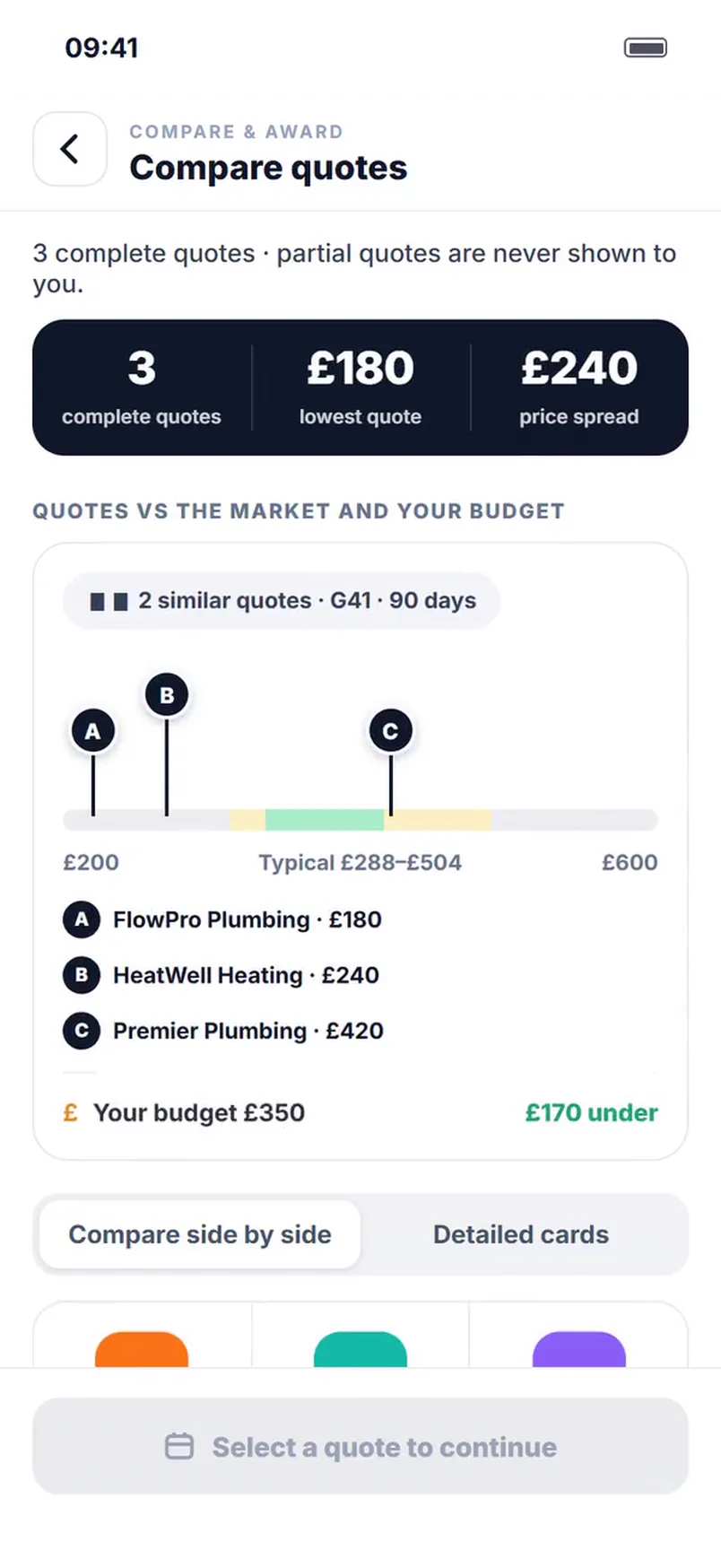
Getting three quotes is the easy part. Comparing them is harder, because no two trades write a quote the same way. One is a single line with a total. Another runs to two pages. A third leaves out the skip, the making good and the VAT. If you just pick the lowest number, you can end up paying more by the time the job is finished.
This guide walks through how to turn three different quotes into a fair comparison.
Start by giving everyone the same brief
Quotes can only be compared if every trade priced the same job. Before you ask anyone, write down:
- what's wrong, or what you want done, in your own words;
- the size of the space, with rough measurements;
- what you're supplying yourself (tiles, a kitchen, a boiler you've already bought) and what you expect them to supply;
- when you'd like it done, and any dates that don't work;
- anything that makes access tricky: stairs, a tenement close, parking restrictions.
Send the same brief and the same photos to everyone. If one trade visits and spots something the others haven't, share it with the others so they can price it too. Our guide to describing a job so trades can quote it has a checklist.
Check whether it's a quote or an estimate
A quote is a fixed price for the work described. An estimate is the trade's best guess, and the final bill can move. Both are fine, as long as you know which one you're holding. If a document says "estimate", ask how far it could change and what would make it change.
Read the scope line by line
This is where most of the difference between quotes hides. For each one, tick off whether it includes:
- strip-out and removal of the old units, tiles or rubble;
- waste disposal, including a skip or a waste carrier, and any permit needed to put a skip on the road;
- materials, and which ones (a quote that says "tiling" might mean their choice of tile, or labour only);
- first fix and second fix for electrics and plumbing, if the job needs both;
- making good: filling, plastering and patching after the work;
- decoration: some quotes stop at bare plaster;
- protecting your home: dust sheets, floor protection, cleaning up.
Watch for two phrases. A prime cost (PC) sum is an allowance for something you'll choose later, like £20 a square metre for tiles. If you pick dearer tiles, the price goes up. A provisional sum is an allowance for work that can't be priced until it's opened up, like rot behind a wall. Both are normal, but two quotes with different allowances aren't comparable until you adjust for them.
Is VAT in or out?
A trade that's registered for VAT has to charge it; one that isn't won't. That can make a smaller firm look cheaper when the real difference is VAT. Compare the total you'll actually pay, with VAT included, and make sure each quote says clearly whether VAT is in the price.
OnBelt lays quotes side by side, in stages, with VAT shown, and keeps the whole job in one place. It’s coming soon.
Get early accessLook at how and when you pay
A quote should say how much is due before work starts, how much at each stage, and how much at the end. A deposit of around 10 to 20 per cent, followed by payments as stages are finished, is common. Be wary of anyone wanting half or more before they've started. Our guide to stage payments explains how to tie each payment to work you can see.
Compare the dates, not just the price
Ask each trade when they could start and how long the work will take. A cheaper quote that can't start for four months might cost you more in a damp room or a kitchen you can't use. Ask too what happens if the job overruns.
Find out who will actually do the work
On a bigger job, the person who quotes might not be the person who turns up. Kitchens and bathrooms often need a plumber, an electrician, a tiler and a plasterer. Ask who each of them is, whether they're employed or subcontracted, and how they're checked. If any gas work is involved, the engineer must be on the Gas Safe Register.
Put it in a table
Once you've read every quote, a simple table makes the differences obvious:
| Quote A | Quote B | Quote C | |
|---|---|---|---|
| Total including VAT | |||
| Quote or estimate | |||
| Waste removal included | |||
| Materials included | |||
| Making good and decoration | |||
| Deposit and stages | |||
| Earliest start and how long | |||
| Who does the work |
Fill the gaps by asking. A good trade won't mind explaining their price, and the way they answer tells you a lot.
Warning signs
- A one-line quote with no detail, for anything more than a small repair.
- A discount if you pay in cash, or if you decide today.
- A large payment before any work starts.
- No address or company details on the quote.
- No clear way of agreeing changes once the job is under way.
How OnBelt makes this easier
On OnBelt, every quote answers the same questions, so they line up side by side, against your budget. Bigger jobs come as one quote for the whole job with every trade named. Prices are split into stages, VAT is shown, and if the job changes on site, the extra is agreed in the app before anyone starts it. OnBelt is coming soon, starting in Scotland's Central Belt.
Frequently asked questions
How many quotes should I get?
Three is a sensible number for most jobs. Fewer and you've little to compare; many more and it becomes hard to keep track, and good trades may not want to quote against a crowd.
Should I always pick the cheapest quote?
No. Pick the quote that gives you the most of what you need for a fair price: the right scope, a clear payment plan, a start date that works and someone you trust. A low price with gaps in the scope often ends up costing more.
Is it rude to ask a trade to explain their price?
Not at all. Asking what's included, and why one item costs what it does, is a normal part of comparing quotes. A trade who won't explain is telling you something.
What if the quotes are wildly different?
It usually means they've priced different jobs. Go back through the scope line by line: one may include waste, making good or materials that another left out. If they still differ after that, ask each one what they've allowed for.