Chasing money is the worst part of the job, and it eats evenings you'd rather spend doing anything else. The good news is that most late payment is preventable. It comes from vague terms, payments left until the end, and invoices that arrive late or unclear. Fix those, and most customers pay on time.
Agree the money before you start
Put the payment terms on the quote, so the customer agrees to them when they accept it:
- the deposit, and what it's for;
- the stages, and what has to be finished for each payment to be due;
- how long the customer has to pay each invoice, for example 7 days;
- how to pay: bank transfer details, and a warning that you'll never change them by email;
- what happens if payment is late.
Our guide to writing a quote that wins the job covers the rest of what a quote needs.
Take a deposit for materials
A deposit means you're not buying materials with your own money for someone else's job. Around 10 to 20 per cent is common for domestic work, more for made-to-order items. Customers understand it if it's explained.
Get paid in stages
On anything more than a few days' work, don't leave all the money to the end. Name stages after work the customer can see ("strip-out and first fix", "roof on", "finished and signed off") and invoice as each one is done. If a customer stops paying, you've stopped working, not finished the whole job unpaid.
Send invoices that get paid
- Send them the day the stage is done, while the customer can still see the work.
- Make them clear: what the payment is for, which stage, the amount, VAT if you're registered, the due date and your bank details.
- Use a unique invoice number and keep a copy.
- If you're VAT-registered, the invoice must meet HMRC's VAT invoice rules. If you're a subcontractor, check whether CIS or the VAT reverse charge applies.
OnBelt puts leads, whole-job quotes, your crew’s calendar and invoices in one app. It’s coming soon.
Get early accessChasing, politely and in order
- A friendly reminder the day after the due date. Assume it's been forgotten: most late payments are.
- A firmer reminder a week later, with the invoice attached and the due date stated.
- A phone call. Ask when they'll pay, and agree a date.
- A formal letter setting out what's owed, the date it was due, and what you'll do next if it isn't paid.
Keep everything in writing, even after a phone call: "Thanks for the chat, as agreed you'll pay the £1,200 by Friday."
Late payment interest on business customers
If your customer is a business (a contractor, a landlord's company, a shop), the Late Payment of Commercial Debts (Interest) Act 1998 lets you charge:
- statutory interest of 8% above the Bank of England base rate, as simple interest, from the day after payment was due;
- a fixed sum on top: £40 for a debt under £1,000, £70 for £1,000 to under £10,000, and £100 for £10,000 or more;
- your reasonable recovery costs beyond that fixed sum.
You don't have to claim it, and often the mention is enough. The Small Business Commissioner has a late payment interest calculator.
This doesn't apply to homeowners. For consumers, you can only charge interest if it was a fair term in the contract they agreed to, so put it on the quote.
If they still won't pay
In Scotland, claims up to £5,000 can go through the sheriff court's simple procedure, which is designed to be used without a solicitor. Bigger claims use other court procedures, and it's worth getting advice before you start. Most debts in Scotland have to be pursued within five years, so don't leave it.
Protect your customers from bank-detail scams
Fraudsters intercept emails and send "updated" bank details to customers. Tell customers at the start that you'll never change your bank details by email, and ask them to phone you before paying if anything changes. It protects your money as well as theirs.
How OnBelt helps
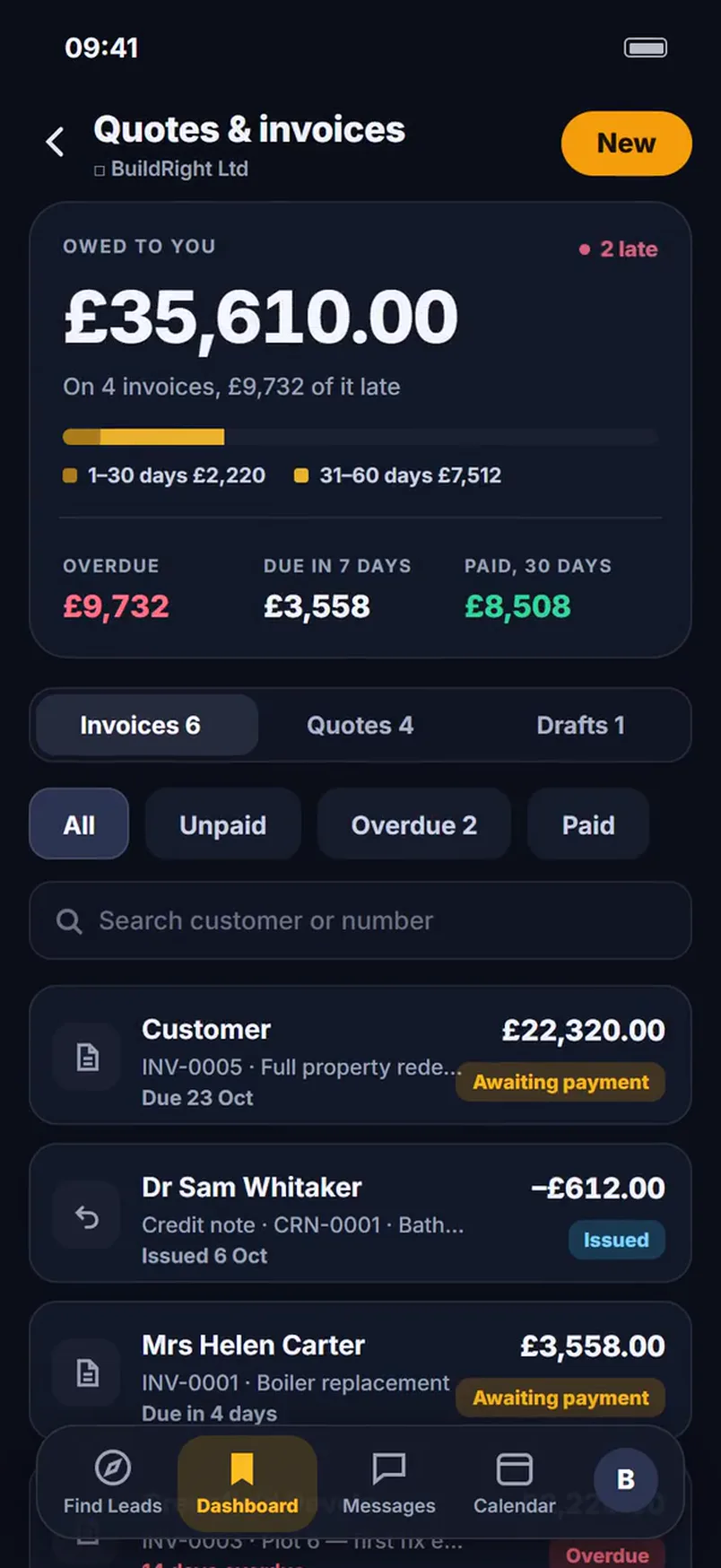
In OnBelt, your quote sets out the stages and the start date up front, and the customer agrees to both. Stages are signed off from photos, so there's no argument about whether the work was done. Quotes and invoices sit together, and you can see at a glance who owes you what. The customer pays you directly; OnBelt keeps the record. OnBelt is coming soon, starting in Scotland's Central Belt.
General information, not legal advice. For late payment interest, see the Late Payment of Commercial Debts (Interest) Act 1998. For court claims in Scotland, see Scottish Courts and Tribunals. Speak to a solicitor about a large or disputed debt.
Frequently asked questions
Can I charge interest to a homeowner who pays late?
Only if it was a fair term in the contract they agreed to. The statutory late payment interest only applies between businesses, so put your terms on the quote.
How much late payment interest can I charge a business?
Simple interest at 8% above the Bank of England base rate, plus a fixed sum of £40, £70 or £100 depending on the size of the debt, and reasonable recovery costs beyond that.
How long do I have to chase a debt in Scotland?
Most contract debts must be pursued within five years. Don't let it drift: the longer you leave it, the harder it is to collect.
Should I take a deposit?
For most domestic jobs, yes: a deposit of around 10 to 20 per cent towards materials is common and reasonable. Explain what it's for.