Most customers get three quotes, and most of them can't tell why one is £800 dearer than another. The quote that explains itself, shows the customer exactly what they're getting and sets out how they'll pay usually wins, even when it isn't the lowest. A clear quote also heads off the "I thought that was included" argument at the end of the job.
Quote or estimate? Say which
A quote is a fixed price for the work you've described. An estimate is your best guess, and the final figure can change. Customers treat them very differently, so label it clearly. If parts of the job can't be priced until they're opened up, quote what you can and show the rest as an allowance (see below).
What every quote should include
- Your details: business name, address, phone, email, and your company number if you're a limited company.
- The customer and the job address.
- The scope, as a list the customer can tick off: what you'll do, room by room or stage by stage.
- Exclusions: what you're not doing. Decoration, making good, waste removal and building warrant fees are the usual gaps.
- Allowances: any prime cost or provisional sums (see below).
- The price, with VAT shown clearly if you're registered.
- The stages and when each payment is due.
- When you can start and how long the job will take.
- How long the quote is valid, for example 30 days, so a price from last spring can't be held against you.
- How changes will be handled: priced and agreed in writing before the extra work starts.
- Your guarantee on workmanship, and your insurance.
Write the scope in the customer's words
"Supply and fit 2no. 600mm base units" means something to you. "Two new cupboards under the window, to match the others" means something to them. Use their language, and add the technical detail underneath if you need it. If they described the job one way and you're quoting something different, say why.
Use allowances honestly
- A prime cost (PC) sum is an allowance for something the customer will choose later, like tiles at £25 a square metre. If they choose dearer tiles, the price moves.
- A provisional sum is for work you can't price until you see it, like replacing joists you suspect are rotten.
Show both clearly, so the customer knows which parts of the price are fixed and which aren't. Two quotes with different allowances aren't comparable, and customers increasingly know it.
OnBelt puts leads, whole-job quotes, your crew’s calendar and invoices in one app. It’s coming soon.
Get early accessShow VAT so nobody's surprised
If you're VAT-registered, show the price before VAT, the VAT, and the total. Customers compare totals, and a homeowner who discovers VAT on top at the end will remember it. If you're not registered, say so: it explains why your price may look lower.
Break it into stages
Stage payments protect you and reassure the customer. A sensible deposit towards materials, then payments as each stage is finished, means you're never funding the job yourself, and they're never paying far ahead of the work. Name stages after things the customer can see: "strip-out and first fix", "tiled and fitted", "finished and signed off". Our guide to getting paid on time goes further.
Agreeing the job in the customer's home? Know the 14-day rule
If a homeowner agrees to a contract during a visit to their home (rather than accepting a quote you send afterwards), they usually have a 14-day right to cancel, under the Consumer Contracts Regulations. You must give them the cancellation information in writing, and you generally can't start in those 14 days unless they ask you to in writing.
Get this wrong and the cancellation period can stretch to a year, and you may have to refund what they've paid. The simplest way to avoid it is to measure up on the visit and send the quote afterwards, so the customer accepts it in their own time. Scottish trading standards explain it well on Trusted Trader.
Send it quickly, then follow up
Speed wins work. A clear quote the same day or the next beats a perfect one a fortnight later. If you haven't heard back in a few days, one friendly follow-up is fine: ask whether they have questions, not whether they've decided.
How OnBelt helps
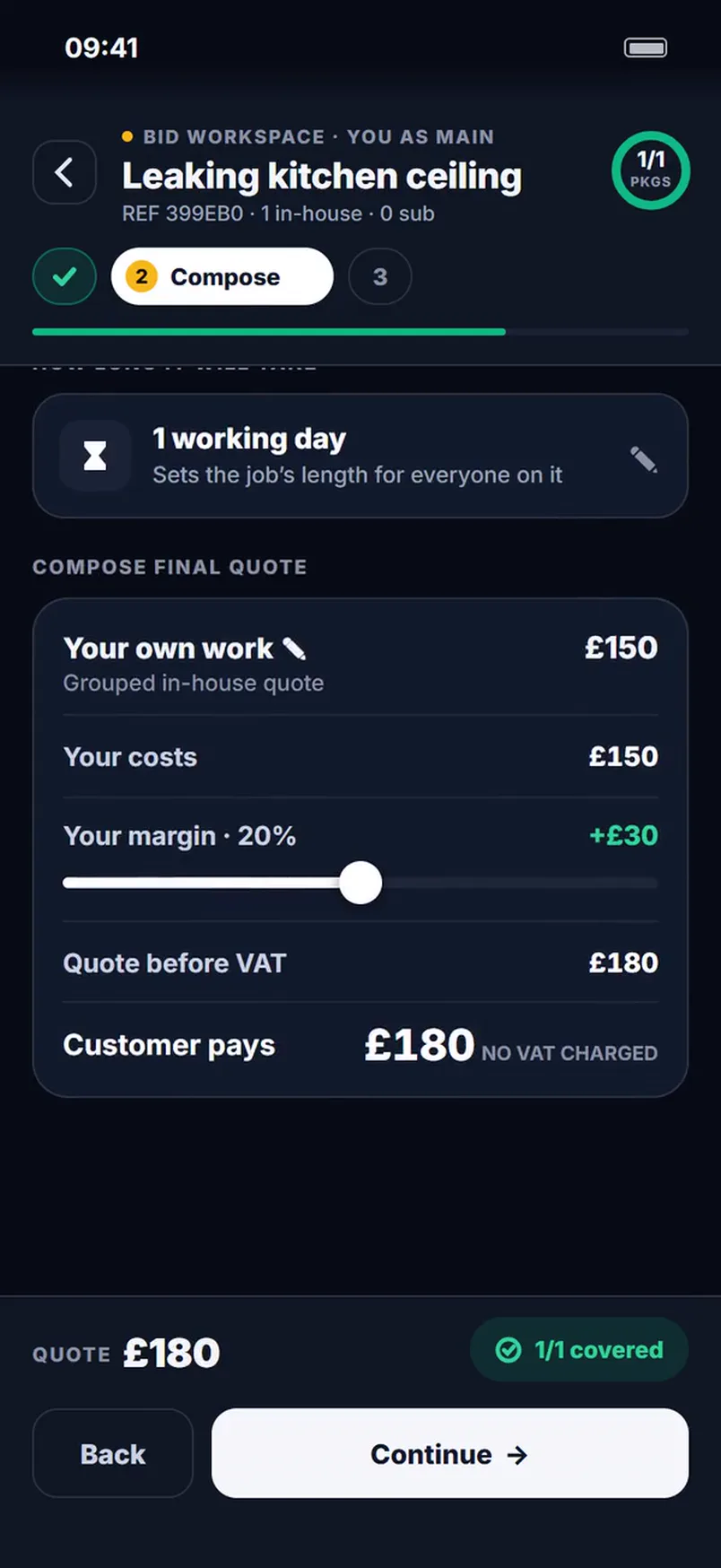
In OnBelt you quote the whole job: price it, split it into payment stages and set a start date, in a format the customer can compare properly. On bigger jobs you can bring your own crew, invite a trade you use, or publish a package to subcontractors, and it all rolls up into one quote. When the customer accepts, you agree the start date together in the app, and the job lands on your calendar. OnBelt is coming soon, starting in Scotland's Central Belt.
General information, not legal advice. Consumer law changes, and your situation may be different. For the cancellation rules, check the Consumer Contracts Regulations 2013 or ask Trading Standards.
Frequently asked questions
How long should a quote be valid for?
Thirty days is common. Material prices move, so a validity period stops an old price being held against you months later.
Should I charge for quotes?
Most trades quote for free for ordinary domestic jobs. For large jobs that need detailed drawings or surveys, some charge and refund it if they win the work. Whatever you do, say so before you visit.
Do I need to show VAT separately?
If you're VAT-registered, show the price, the VAT and the total, so the customer sees what they'll actually pay. If you're not registered, saying so explains why there's no VAT on your price.
What if the job changes after I've quoted?
Price the change and get it agreed in writing before you start the extra work. Add it to the stage it belongs to so the payment plan stays accurate.